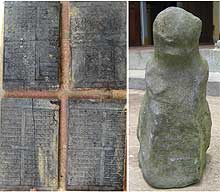
 The
wooden blocks are each 18cm wide, 25cm long and 2cm thick, and divided
in four equal parts. The ancient Chinese characters inscribed upon them
were all in high relief.
The
wooden blocks are each 18cm wide, 25cm long and 2cm thick, and divided
in four equal parts. The ancient Chinese characters inscribed upon them
were all in high relief.
The 40cm high monolith made of grey brown stone depicts a thoughtful-looking woman, bending over with her head lowered.
The director of the Ha Tinh Museum Tran Hong Dan told that although
the origin, date and style of the statue have not yet been definitely
identified and the ancient Chinese script on the wood blocks has not yet
been decoded, he believed the four engraved wood blocks belonged to the
18th century.
The archaeological expert said he based his evaluation on his own
experiences as well comparisons with over 400 other engraved wood blocks
being kept at the shrine of the Nguyen Huy Tu family in Ha Tinh
Province.
Previously, the provincial Department of Culture, Sports and Tourism and the Vietnam Archaeological Institute identified 15 ancient Champa water wells in the province.
These water wells are in square or round shapes and just between 2
and 5m deep but have never been dry even in droughts, said a Deputy
Director of the Heritage Management Department under the provincial
Department of Culture, Sports and Tourism.
Ho Bach Khoa added the a survey on a large scale is to kick off soon
to date the finds and study the structure as well as the skills used by
ancient people in building water wells.